
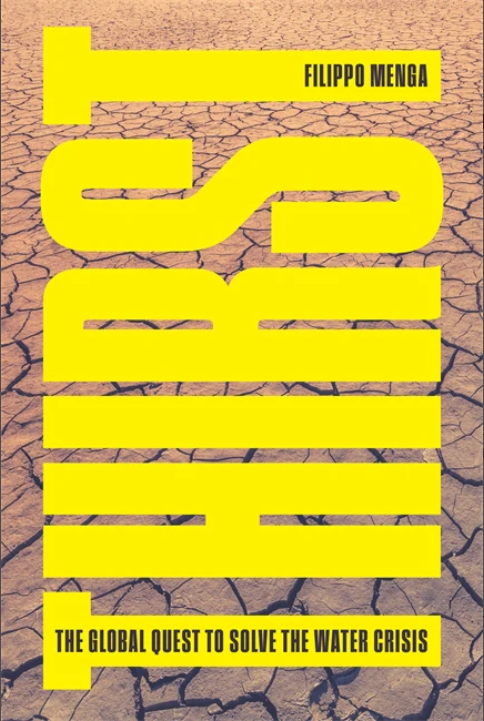
Menga, F. 2025. Thirst: the global quest to solve the water crisis. Verso Books. ISBN: 9781804290712, 208 p., $24.95.
(URL: https://www.versobooks.com/products/3012-thirst)
Gabrielle Bouleau
UMR LISIS, UGE, CNRS, INRAE, F-77454 Marne-la-Vallée, France
To cite this review: Bouleau, G. (2026). Review of of “Thirst: the global quest to solve the water crisis", Verso Books, by F. Menga, Water Alternatives, https://www.water-alternatives.org/index.php/bor/770-thirst
Thirst: the global quest to solve the water crisis is a short essay published in 2025 by geographer Filippo Menga, Associate Professor of Geography at the University of Bergamo and Editor-in-Chief of Political Geography. The 194 pages are easy to read, and aim at raising criticism among a large audience towards the new role of philanthropy in the water domain. If you have ever considered donate to solve the global water crisis, you should read this book first. Menga convincingly argues that your gift benefits more to save the reputation of companies grabbing water than it alleviates drought consequences for water-deprived communities.
This essay draws on four types of source: examples of injustice in the face of extreme droughts, such as the suspension of the public water supply in Mexico City in May 2022 whilst soft drink and beer companies continued to draw water; an investigation into the activities of two charitable organisations (WaterAid and Water.org); a critical account of the campaigns made by bottled water companies; and a large scope of academic research made highly accessible by the author’s lively style.
Whilst WaterAid is a collective initiative by the UK water sector in response to the United Nations’ call for the Decade of Water and Sanitation, Water.org was founded by an engineer-turned-entrepreneur in partnership with the actor Matt Damon. However, both charitable organisations share a common aim: to support fundraising efforts to tackle the global water crisis.
Menga invites us to consider how these actors frame the public issue—as a global crisis for which no one is to blame, caused by structural factors such as population growth or underdevelopment, possibly mitigated by local technical solutions, thanks to celebrities acting as major donors and additional contributions from consumers in wealthy countries. “Many of us take for granted the fact that billionaires have to be on the frontline of the world’s water crisis, and that is part of the problem” (p.169). Shouldn’t we be wary of an agenda devised and promoted by extremely wealthy celebrities? Menga highlights the neoliberal underpinnings of this conceptual framework, which focuses on the individual whilst overlooking the need for a political overhaul of our social metabolism (p.74). This framing presents the voluntary sector as a necessary intermediary between global problems and local technical solutions. But as Menga brilliantly demonstrates, this intermediation often works by encouraging individuals to act not as citizens, but as consumers of bottled water who can help fund the cause through their purchases.
Menga highlights the problematic links between these philanthropic organisations and bottled water companies. These companies promote the unrivalled purity of bottled water, yet their PET packaging releases microplastics. They fund educational campaigns on the importance of recycling and small water-saving measures, whilst their excessive pumping threatens access to water for many communities.
The book’s originality, however, lies not merely in its critique of a neoliberal narrative that obscures the socio-environmental impacts of bottled water. Menga argues we are facing a new religion that exploits the spontaneous compassion we cannot suppress when faced with images of others’ suffering (Fuyuki Kurasawa’s concept of visualities of humanitarianism: p.103). Our natural inclination to care for others is then channelled into a supposedly virtuous act of consumption. All it takes is to buy a bottle from a brand committed to save the ‘global water crisis’ in partnership with charities, and the purchase will act as a fetish. According to Menga, the fabulously wealthy celebrities who publicise their donations to communities lacking access to water are acting like the priests of a new church who make Western consumers feel guilty and offer them a form of redemption through financial sacrifice – a new form of the sale of indulgences. But Menga warns us against this sacrifice, which does nothing to resolve the injustices of water grabbing and rather increases the priest’s power. This church, funded partly by the corporate social responsibility initiatives of bottled water companies and partly by other wealthy patrons who see it as an opportunity for self-promotion, is, according to Menga, yet another ploy by capitalism to allow industries to rid themselves of their culpability and their debts towards the ecosystems and communities they have impacted.
However, these donations, which are often tax-deductible, do not simply improve the situation of disadvantaged communities for free. Very often, they serve as seed funding and co-financing for banks that sell microloans locally, enabling the poor to self-finance emergency water infrastructure.
I was less convinced by the author’s argument, which draws on the metaphor of religion by claiming that free gift is the taboo of capitalism, one only tolerated when linked to consumer purchases. I also felt that the author’s argument in favour of a universal right to water deserved a little more nuance, particularly in arid regions, as argued by Karen Bakker (2007). I also find the portrayal of the welfare state as a collateral victim of the discourse on the global water crisis somewhat exaggerated; these states were not the last to support extractivist practices. Finally, Menga focuses heavily on urban issues; it seems to me that Julie Trottier’s insights into the different frameworks of the water crisis provide a useful complement to this analysis (Trottier 2008).
Despite these limitations, I agree with Menga’s conclusion. He urges us not to believe the advertising campaigns of bottled water companies, which portray nature as separate from humanity. On the contrary, he concludes that we must take care of our water (p.175), and that bottled water is a luxury we can no longer afford when tap water is available (p.174).
References
Bakker, K. (2007). "The “Commons” Versus the “Commodity”: Alter-globalization, Anti-privatization and the Human Right to Water in the Global South." Antipode 39(3): 430-455.
Trottier, J. (2008). "Water crises: political construction or physical reality." Contemporary Politics 14(2): 197-214.