
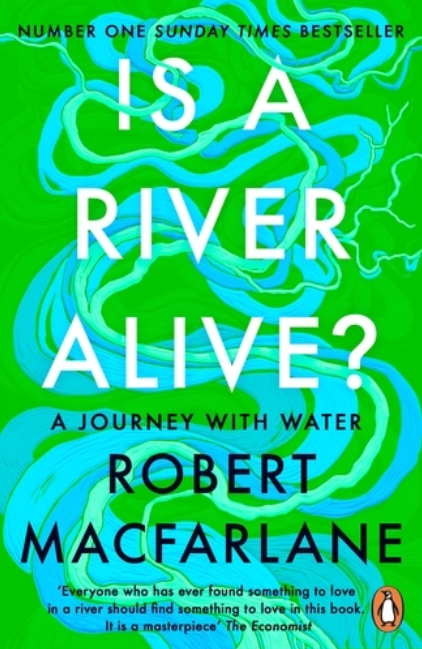
Macfarlane, R. 2025. Is a river alive? New York: Norton. ISBN: 9780241998212, 384 p., £11.99.
(URL: www.penguin.co.uk/books/455147/is-a-river-alive-by-macfarlane-robert/9780241998212)
Emanuele Fantini
IHE, Delft, The Netherlands
To cite this review: Fantini, E. (2026). Review of of “Is a river alive? Norton, by R. McFarlane, Water Alternatives, https://www.water-alternatives.org/index.php/bor/771-alive
“Of course, a river is alive! Do you really need to read a whole book to know that?” This was my seven-year-old son’s reaction when he glanced at the title of the book I was reading: Is a river alive? by the acclaimed British writer of nature, place, and people, Robert Macfarlane. While admiring the child’s honesty, I was glad I devoured the book. Written in lyrical prose, it offers a lesson on how we come to know water and, through its inquiry on the right of the river, a broader meditation on what it means to be alive.
Macfarlane’s journey to answer the question in the book’s title takes him along three riverine landscapes: the cloud forest and Rio Los Cedros in Ecuador; the creeks, lagoons, and estuaries in Chennai, India; and the Mutehekau Shipu - also known as Magpie River - in Nitassinan, eastern Canada, homeland of the Innu people. In all these places rivers are considered living entities by those who inhabit them, while simultaneously under severe threat by extractive practices such as mining in Los Cedros, pollution in Chennai, and dam construction in Nitassinan.
In the prologue, interludes, and epilogue, these three expeditions are interwoven with the story of the Nine Wells springs, in the backyard of the author’s house in England. These sections connect past, present, and future, weaving distant rivers and people into familiar, intimate places. Macfarlane imagines the birth of the springs and their future beyond his lifespan, hinting at the incommensurability of nature and human temporalities. And when he shares the book’s title with one of his children during a playful walk at the springs, the son has the same reaction as mine: “Well duh, that’s going to be a short book then, Dad, because the answer is yes!” (p. 16).
This directness is echoed by the schoolchildren who joined Macfarlane birdwatching in Chennai, whose answer was equally unequivocal: 'Yes, a river is alive!' (p. 145). That made me wonder why, as adults, we need so many words to affirm what comes instinctively to children. Throughout the book, Macfarlane embraces this child-like perspective, the 'lawless merriness' (p. 300) he sees in one of his sons, asking big questions with spontaneity and delighting in the wonder of discovery.
There is a growing recognition in academic literature, activist practices, and artistic expression that rivers – and nature in general – have rights. What does this non-fiction narrative book contribute to this conversation? How can it be relevant for research and education? While most of the literature on the rights of the rivers seems to reassert the “what”, Macfarlane explores the “how”. He offers a lesson on how we can and should get to know water, rivers, and their rights from a more-than-human perspective, combining evocative writing, relational encounters, and embodied experience.
In one of his previous and most popular books, “The Lost Words” (2017), Macfarlane salvaged the everyday nature words that were removed from an official children’s dictionary in the UK, deemed disused. He shows instead the magic of those words in allowing us to celebrate and care for the animals and plants we share the world with. Not being an English native speaker, when reading “Is a River Alive?” I had to resort to the dictionary – or to the useful glossary at the end of the book – to learn new terms about the natural word that I rarely meet in academic work on water. It was demanding but rewarding. Not only was this a warning against the aridity of academic language. More importantly, it recalled that rights are a matter of language too; that taking the floor, giving voice, and naming are basic acts of representing and reclaiming rights. Macfarlane’s evocative writing thus invites us to reflect on how affirming new rights like those of rivers requires rethinking our forms of expression and their effects in terms of representation, both analytical and political.
And yet, in a few passages of the book, Macfarlane admits lacking the words in front of unfamiliar water landscapes. He acknowledges the need and the joy of exploring them with the guidance and companionship of three stewards of those landscapes: Giuliana Furci, a Chilean-Italian-British mycologist; Yuvan Aves, a self-taught naturalist, teacher, and activist who founded a trust fighting for the rights of humans and non-humans in Tamil Nadu and beyond; and Rita Mestokosho, Innu poet, activist, and community leader, whose quote opens the third part of the book on the Nitassinan: 'We've always known the river is alive' (p. 195). In his interactions with these guides, Macfarlane shows how we come to know water through relations. People's stories and characters allow him to discover different modes of relatedness, such as branching in the Ecuadorian cloud forest, circulation in Chennai's rivers, and free flowing along the Nitassinan. Learning about these relations, he develops a 'grammar of animacy' (p. 183) based on the principle shared by Yuvan that 'to be is to be related' (p. 178). He also meditates on what it means to be alive by confronting death — the death of the loved ones his travel companions are mourning: a father, a sister, a friend, but also Chennai's creeks. As the book closes: 'death and love and life all mingled in the flow' (p. 301)."
Ultimately, the book is an ode to experiential learning that celebrates the beauty of engaging with the materiality of water, and the pleasure of being immersed in it. Macfarlane’s descriptions of his exploration of the cloud forests, walks along the Indian rivers, and kayak descent of the Nitassinan make the reader yearn to join the expedition. Quoting Rita Mestokosho - “My people wrote while walking” (p. 221)- Macfarlane indicates that to truly know a river, you need to experience and feel it, and concludes that “flowing and knowing are indissoluble” (p. 183). Thus, the book can be a source of both inspiration and confirmation for the growing number of researchers experimenting with walking and other sensorial methods in river studies.
What emerges from these three strands is a new kind of 'water literacy' (p. 183), unlearning the binaries that structure so much of our thinking: water and land, humans and non-humans, life and death. Through evocative writing, relational encounters, and embodied experience, Macfarlane makes it feel not just plausible but natural that a river is alive and has rights. Natural in the double sense of the word: rooted in the nature of things, and simply to be expected, happening - as he shows - in the ordinary course of life, flows, and relations. And so, by the time we reach the last page, we are ready to join what feels like a growing choir. The answer to the book's title is no longer a child's instinctive "well duh" but a hard-won and joyful yes!