
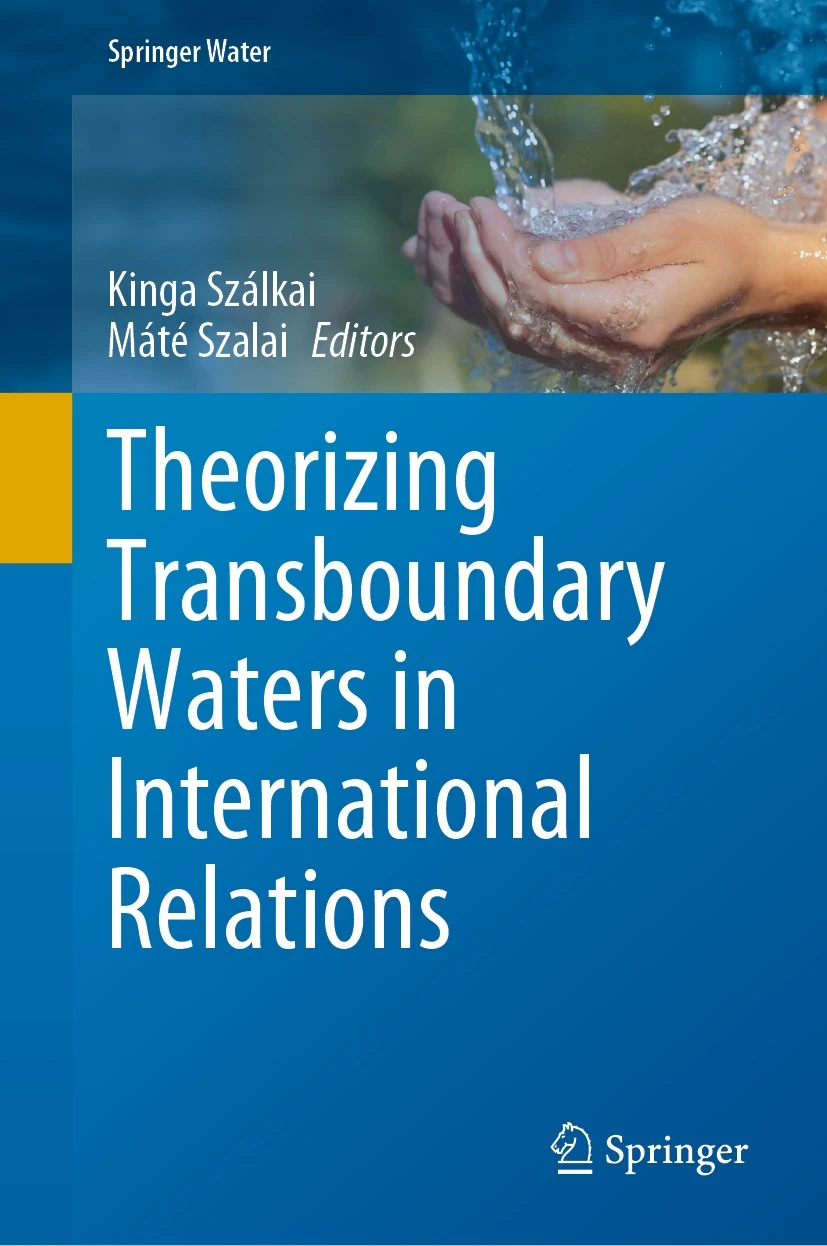
Kinga Szálkai and Máté Szalai (Eds). 2023. Theorizing transboundary waters in international relations (Springer Water). Pp. x + 256. ISBN 978-3-031-43375-7 (cloth), USD 129.99.
URL: https://doi.org/10.1007/978-3-031-43376-4
By Larry Swatuk
Waterloo University, Canada
To cite this review: Swatuk, L. 2026. Review of “Theorizing transboundary waters in international relations”, Springer by Kinga Szálkai and Máté Szalai, Water Alternatives, https://www.water-alternatives.org/index.php/bor/764-theo
In their introduction to Theorizing Transboundary Waters in International Relations, the editors outline the task they set for themselves and the contributors to this interesting volume:
[T]o contribute to the literature on the explicit theorization of transboundary water issues within the discipline of International Relations… to contrast the traditional and the current theoretical approaches towards understanding the general dynamics of transboundary water conflict and cooperation; to collect the latest state-of-the-art findings of scholars working on the theorization of transboundary water relations; and to demonstrate that new and transformative perspectives can arise in the intersections of theory and practice, which can have a significant added value not only for academics, but also for practitioners and other stakeholders, while fostering the discussion in the global water community (p.2).
Their point of departure is the nearly two-decades old conversation between Kathryn Furlong (2006; 2008) and Jeroen Warner and Mark Zeitoun (2008) that appeared in Political Geography. From Furlong they take her observation that ‘the application of IR [International Relations] theories in transboundary water analysis is “implicit and unacknowledged”’. From Warner and Zeitoun (2008: 802) they highlight the claim that there was some distance still to go in convincing the global water community that “water is politics” (p.2). What has been achieved in the interim? Is there evidence of explicit deployment of IR theory in the analysis of transboundary water politics? What is achieved by the explicit application of IR theory to transboundary water issues and cases? Do insights from the global water community enrich IR theory/theorizing?
To answer these questions, the editors bring together eighteen authors to write a dozen chapters (plus an introduction and conclusion) organized into four sections of three chapters each: Part 1 revisits IR’s so-called ‘grand theories’ – (neo)realism, (neo)liberalism, constructivism – in the context of transboundary water politics (TBWP); Part 2 presents a series of case studies focused on conflict and cooperation over TBWP; Part 3 focuses in on various aspects of TBW diplomacy; and Part 4 showcases what they call ‘new perspectives’.
The cases and places described, and the theories deployed reflect the authors’ particular interests and expertise, with a heavy emphasis on the ‘hard cases’ – Tigris-Euphrates, Lancang/Mekong, Aral Sea, Helmand, Nile, Jordan – and difficult places – Turkey, Israel, Pakistan. In the section on ‘new perspectives’, there are two very interesting cases: one centred on the Danube and one on Small Island Developing States (SIDS). There is also a chapter focused on Indigenous sovereignty in the Columbia River Basin in North America.
Chapter 2 (Al-Muqdadi) presents a smorgasbord of IR theories before applying a highly mechanistic five-phase ‘hydropolitical cycle’ to the case of TBWP in the Tigris-Euphrates. The author presents a global governance approach (inexplicably separated out from neoinstitutionalism) alongside their support for dam indexing as a means for improved transboundary water governance. Chapter 3 (Ahmadzai) challenges IR theory tendencies to reify the sovereign state by demonstrating the power of sub-national (i.e. the military) and supra-national (the World Bank) actors in affecting water management decisions in Pakistan. Ahmadzai makes the interesting claim that this ‘nexus has transformed transboundary water into a profit-based landscape that strategically and intelligently exercises institutional and discursive power to establish a monopoly over hydro-politics at domestic and global levels’ (p. 45). Sharipova (Chapter 4) argues that TBWP would benefit from investigating the role and impact of ‘affective factors’ (trust, emotions, perceptions, sympathy, antipathy) in determining conflict-cooperation relations and outcomes. “These affective factors cannot be explained through a rationalistic stance, which assumes that states only act with the aim of maximizing their benefits” (p. 52). As such, Sharipova argues, (neo)realism and neoliberal institutionalism are of limited explanatory value: Given that ‘[g]overnments or states, being social constructions, only exist in virtue of the practices that instantiate them’, social constructivism is the IR theory best able to accommodate affective factors. This is demonstrated through two very short examples.
In Part II, Vörös (chapter 5) faithfully applies Zeitoun’s and Warner’s hydrohegemony theory to dissect Chinese dominance in the Lancang/Mekong. In Chapter 6, Ghoreishi, Mianabadi and Jafari reframe TBW security through a ‘nexus’ approach as applied to Afghanistan’s transboundary river basins. The authors argue that TBW security must be analysed through the complex lens of multiple security referent objects: state, development, society and ecosystem (in particular, see Table 6.1 on p.92). Dirioz (Chapter 7) “identifies the elements that create a political and social environment conducive to water cooperation, using the case study of the Water for Peace (WfP) initiative by Türkiye and Israel in the early 2000s” (p. 105). While ultimately a failure, the case study “draws attention to the importance of maintaining dialogue” and concludes “that civil society can play a significant role in sustaining dialogue and that sustained dialogue may help reach a certain degree of understanding as well as possible temporary agreements, which may eventually be milestones in the course of adopting a more permanent strategy” (p. 106).
Part III turns specifically to water diplomacy in theory and practice. Kibaroglu (Chapter 8) draws on multi-track diplomacy, the role of international water law and ideas such as ‘benefit sharing’ to illustrate the practical value of the Euphrates Tigris Initiative for Cooperation. Szálkai and Durfee (Chapter 9) speculate on the possibility of a shared interest such as bringing back the salmon to help move the existing Columbia River Treaty beyond its high-modern conceptualization toward an agreement which centres on ecosystem sustainability and respect for Indigenous rights and values. Chapter 10 (Loodin, Eckstein, Singh and Sanchez) begins by acknowledging that “sharing scientific information is the foundation for the successful negotiation of agreements between riparian states” before delving into the challenges of data sharing and trust building. The authors draw on Ajzen’s (1985) theory of planned behavior (TPB) in the broader context of neoliberal IR as developed by Keohane and Nye (1973). The authors seek to align actor-centric analysis focused on affective elements (e.g. pride, fear) embedded in TPB with neoliberalism’s institutional/structural approach. They demonstrate the utility of this theoretical framework through a case study of the Helmand River Basin and state “the incorporation of constructivist elements into a model of neoliberalism may lead to the sustainable utilization of a shared river through a reliable data sharing mechanism” (p. 186).
Part IV turns to ‘New Perspectives’, focusing on discourse analysis (Ezbakhe, Chapter 11), river basin security through a public health lens (Marton, Chapter 12), and transboundary salt waters shared among small island developing states (SIDS) (Szalai, Chapter 13). Each of these chapters, like the others before them, offer interesting perspectives and insights. Ezbakhe’s chapter would have benefited by presenting a precise working definition of water politics discourse or water security discourse at the outset of their chapter. Instead they present a whole range of partial definitions and claims to utility before actually arriving at a specific – and in my view highly relevant – definition from Hajer (2006) on p. 203: “discourse can be seen as the ‘ensemble of ideas, concepts, and categories through which meaning is given to social and physical phenomena, and which is produced and reproduced through an identifiable set of practices’ (Hajer 2006:67)”. Had the author started from this point, they may have been able to develop their important idea that what is needed is “a more structured and transparent way to identify and examine Hajer’s middle-range concepts of storylines and discourse coalitions” (p. 205).
In Chapter 12, Marton’s idea to use public health as the lens to examine TBW management in the Danube Basin illustrates the value in inter-disciplinary approaches to socio-ecological analysis. In examining ‘water-mediated’ (water-borne, water-washed, water-related, water-based) diseases and ‘river-mediated’ effects with a focus on upstream-downstream structural characteristics, the author presents a novel way of considering the complex security nexus described in chapter 6. While Szalai’s focus on SIDS in Chapter 13 is certainly novel, it is the most theoretically orthodox of all the chapters, turning as it does on the ontological framing of ‘small states’ and ‘great powers’ so widely accepted across the so-called ‘neo-neo synthesis’ (Furlong, 2006: 441; Warner and Zeitoun, 2008: 803).
In their conclusion, the editors claim to have contributed to a number of ongoing discussions in the transboundary water literature: “contrasting the application of grand theoretical schools and mid-level theories; taking into account the consequences of the interdisciplinarity of the field; connecting material and immaterial factors more organically; finding synergy with IR-adjacent areas of research; surpassing the traditional conflict-cooperation nexus in security studies and water diplomacy; and identifying the practical relevance of the TWP literature” (p. 248). It would be difficult to argue that they haven’t achieved this, so full of ideas, concepts, theories, cases and approaches is the collection. But the book has failed to achieve the lofty goal the editors set for themselves as stated at the outset of this review, particularly the claim that this would be a state-of-the-art collection. It is, at best, indicative of current debates and directions – a workbook of TBWP theory and practice.
Clearly, the answer to the question ‘has there been much theorizing in TBWP over the last twenty years?’ is an unequivocal yes. However, when it comes to the utility of IR theory to TBWP, I would argue that the book provides no clear answer. The ‘territorial trap’ (Furlong, 2006) guarantees that orthodox IR approaches to water as a resource will continue to inform and infuse state policy and practice. That the dominant discourse turns on notions of ‘increasing pressure’ (p. 2), ‘scarcity’, and climate change, will only reinforce the central position of orthodox analysis. That the results will continue to be suboptimal (and many of the harms probably self-inflicted) will do little to displace this ‘hegemonic discourse’. It is without doubt that other ways into the water (surface, ground, atmospheric, salt, virtual) domain provide important insight – as demonstrated in most of the chapters in this collection. In addition, there are many other theoretical frameworks at play in the water and related resources space that add value but are not considered here. I encourage the editors to reassemble the contributors and consider more carefully and less eclectically (in volume 2) the paradox of sovereign states, obliged to obey no other entity, tasked with managing a fugitive collective good. The starting point could be a more nuanced engagement with the substantive points made by Furlong, Warner and Zeitoun so many years ago. They are all still in play.
References
Ajzen, I. 1985. From intentions to actions: a theory of planned behaviour. In: J. Kuhl and J. Beckmann, eds. Action Control. Springer: Berlin & Heidelberg, pp. 11-39.
Furlong, K. 2006. Hidden theories, troubled waters: International relations, the ‘territorial trap’, and the Southern African Development Community’s transboundary waters. Political Geography 25: 438-458.
Furlong, K. 2008. Hidden theories, troubled waters: Response to critics. Political Geography 27: 811-814.
Hajer, M. 2006. Doing discourse analysis: coalitions, practices, meaning. In: M. van der Brink and T. Metz, eds. Words matter in policy and planning – discourse theory and method in the social sciences. Koninklijk Nederlands Aardrijkskundig Genootschap, Utrecht, pp. 65-74.
Keohane, R.O., and Nye, J. 1973. Power and interdependence. Survival 15(4): 158-165.
Warner, J.F., and Zeitoun, M. 2008. International relations theory and water do mix. A response to Furlong’s troubled waters, hydrohegemony and international water relations. Political Geography 27: 802-810.