
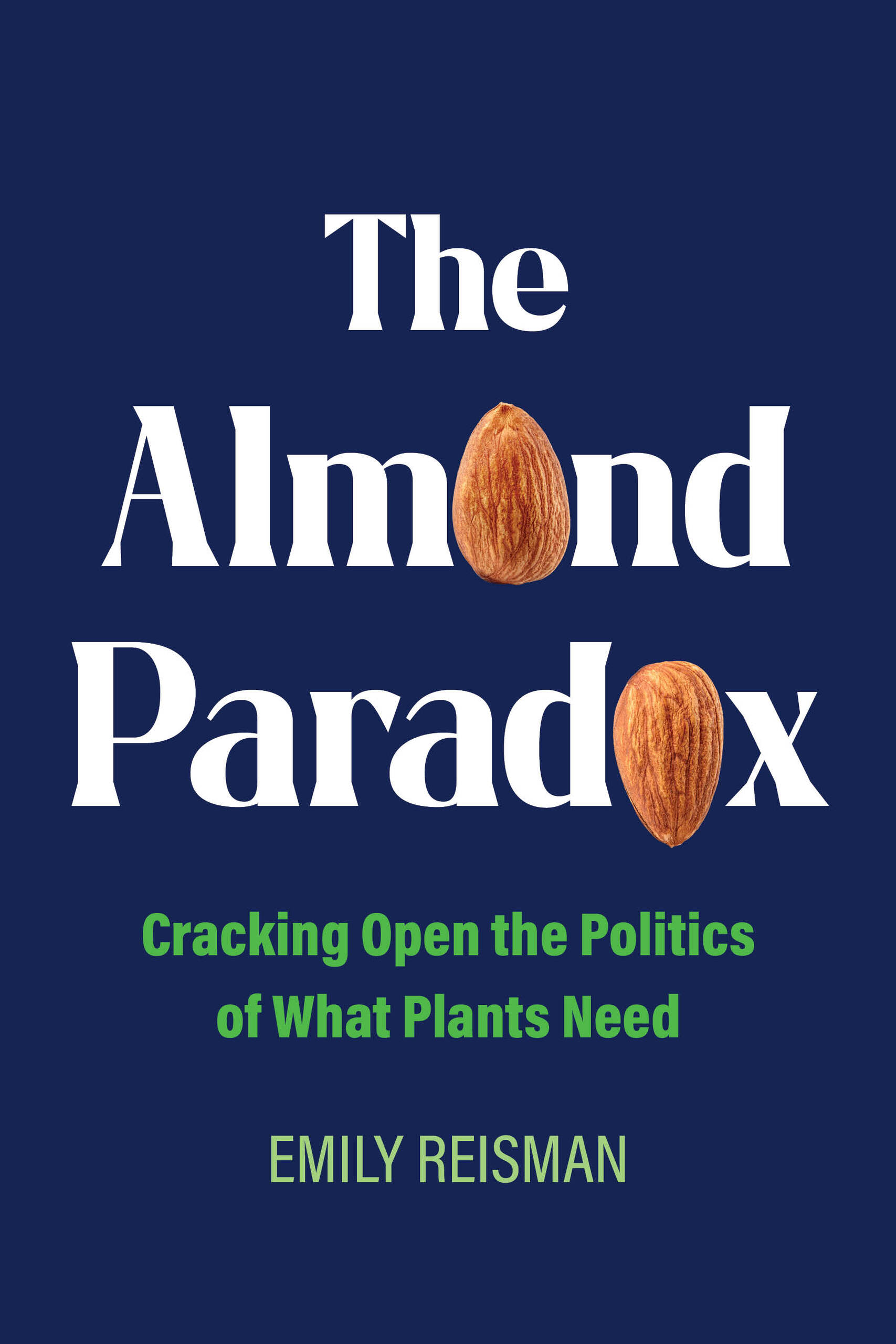
Reisman, E. 2025. The almond paradox. Cracking open the politics of what plants need. University of California Press. ISBN: 9780520413832, 186 p. $34.95.
URL https://www.ucpress.edu/books/the-almond-paradox/paper
Zachary Sugg
Lincoln Institute of Land Policy, zsugg@lincolninst.edu
To cite this review: Sugg, Z. 2026. Review of “The almond paradox. Cracking open the politics of what plants need”, University of California Press, by E. Reisman, Water Alternatives, https://www.water-alternatives.org/index.php/bor/768-almond
In Spain, the almond tree was traditionally a marginal plant, relegated to interstitial and steep ground unsuitable for other crops. Highly drought tolerant, the Spanish almond is a paragon of efficiency and resilience. Yet in the Central Valley of California, almonds are irrigated with upwards of fifty inches of water per year. How can two places growing the same crop in similar climates have drastically different understandings of what that plant needs? That is the puzzling premise of The Almond Paradox by Dr. Emily Reisman.
In the process of interrogating this paradox, Reisman deconstructs the scientific and technical knowledge underpinning ostensibly neutral, objective claims about the needs of almonds. This is motivated by a concern with extractive farming, defined not as a material process like groundwater overdraft, but rather "a logic in which matter (both living and nonliving) is manipulated in ways that generate short-term profit while undermining longevity or renewal" (p. 3). Dismantling extraction requires politicizing narratives and claims about what almonds require. But as the author states at the beginning, the larger message of the book is not really about almonds, but rather how knowing almonds helps us think critically about the taken for granted understandings that sustain extractive agricultural production more generally.
The introduction articulates the author's theoretical-analytical orientation, which combines agrarian political economy and feminist science studies to interpret qualitative evidence collected from fieldwork in the almond growing regions of California and Spain. The ensuing analysis is comparative but unconventionally employs what the author calls a "diffractive" approach, which entails reading two cases "through" each other in a relational way instead of systematically. The rationale for this approach is that each case “exposes and amplifies the significance of the other", yielding certain insights that could not have been gleaned from each case individually (p. 33). I found this methodology inventive and productive, though I can imagine it being too fuzzy for some.
As explained in Chapter 1, the titular paradox originates in California’s adoption of the "paper-shell" Nonpareil almond in California, which is less resilient than the hard-shell Spanish Desmayo but capable of higher yields if provided sufficient inputs. The story focuses on the role of plant breeding science and the values that influenced the promotion of the different types of almonds in the two cases. While California's adoption of intensive farming practices helped it dethrone the Desmayo on the global market, it also instantiated persistent structural problems such as periodic overproduction crises and the long-term degradation of the industry's own natural resource base.
This illustrates the central metaphor propelling the book, the "treadmill" of production, which is characterized by this pattern: an initial technical intervention improves yield but introduces an economic or environmental problem. That problem is addressed with more intensive practices and technology, generating another problem, and so on. The imperatives of yield and profit maximization dictate that the treadmill only ever intensifies, causing the production system to become more susceptible to input disruptions.
Chapters 2 and 3 delve into the nuances of this general pattern for two inputs (water and pollinators, respectively). Special attention is paid to how agronomic knowledge shapes and is shaped by the dynamics of the treadmill. The example that will likely be of special interest to W.A. readers is the account of how and why the crop ET requirement for almonds, a mathematical constant, was continually revised upwards since the 1970’s in California. Reisman analyzes archives and interviews to show how this mundane number was imbricated in a network of agronomists, extension agents, corporate growers, and other actors in service to higher yields.
Crucially, the increase in the ET constant went hand in hand with the adoption of precision irrigation and a suite of other intensive methods promoted by research entities. In an instructive textbook case of the Jevons paradox (a paradox within the almond paradox!), the cost savings of efficiency improvements were put into expanded production, leading to greater overall water consumption.
Through this case study, Reisman troubles a common narrative about the environmental benefits of irrigation efficiency, arguing that "[a] relentless focus on efficiency and precision in the hope that a profit-boosting tactic will conveniently deliver ecological integrity is doomed to fall short" (p. 74).
The metaphor of symbiosis in chapter 3 is two-fold: the biological plant-pollinator relationship, and the “highly profitable and highly precarious” economic dependence between California almonds and the U.S. beekeeping industry. This chapter questions the claim perpetuated by agronomic reports and the media that almond trees require bees for pollination, which seems dubious given that in California they once did not, and in Spain still do not.
Chapter 4, “Space,” looks at how almond production, driven by high prices, has migrated to increasingly precarious areas in both countries in recent years. By the logic of efficiency, these shifts are quite rational. This leads Reisman to consider the different answers to the question of what is the right place for almonds to grow? The author argues for the primacy of place: “[b]y excluding any awareness of place-based concerns, efficiency logics can actually encourage and justify spatial shifts toward problematic places” (p. 102).
Being familiar with the controversy surrounding almond production and water in the Central Valley since the 2014 drought, I wondered how much I might learn from The Almond Paradox. A great deal, it turns out, and not just because so much of it is not about water. Based on its critical stance, the book will probably find the strongest purchase with political ecologists. But thanks to its breadth and broader applicability, I expect it will also appeal to an array of interests, e.g., food and agriculture systems, water resources, resilience and adaptation, resource geography, and science studies. 1 Even apart from the subject matter, it will likely be instructive to scholars for its innovative methodological approach. However, I do question whether it will reach certain audiences who are invested professionally in the kinds of narratives and claims which the author critiques.
Thankfully, the Almond Paradox is not the sort of book to prescribe small-bore changes in markets or consumer behavior. It leads us to question what we know and reminds us to be vigilant for the political disguised as natural. It also speaks to the value of comparative scholarship. While the California case by itself makes it possible to say: "it could be otherwise", reading it through the Spanish case and vice versa pushes us further to think what "otherwise" might actually mean.
- For example, see the recent discussion of agricultural transformations in relation to global water sustainability in the UN University report, Global Water Bankruptcy (Madani, K., 2026, p. 51).