
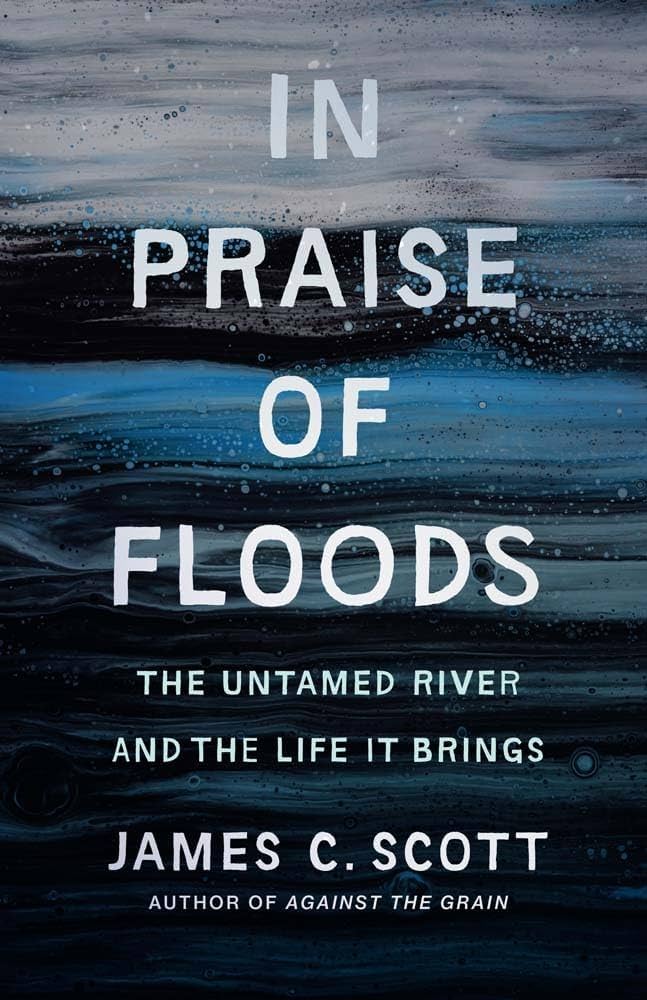
 Scott, J.C. (2025). In Praise of Floods: The Untamed River and the Life It Brings. Yale University Press: New Haven. ISBN 9780300278491 (hardback; $28)/ ISBN 9780300281569 (ebook, $20)/ ISBN 9780300292305 (paperback, $20). 248 p.
(URL: https://yalebooks.yale.edu/book/9780300278491/in-praise-of-floods/)
Kaniska Singh
IIT Bombay, India
To cite this review: Singh, K. (2026). Review of “In Praise of Floods: The Untamed River and the Life It Brings”, Yale University Press, by J.C Scott, Water Alternatives, https://www.water-alternatives.org/index.php/bor/774-praise
It was James Scott's online lecture by the same name that gripped me as a South Asian flood researcher working on one of the Indian Himalayan Riverplains, prompting me to uncover what a prominent political scientist had to say about rivers and floods. The title alone stirs curiosity and discomfort within a contemporary governing culture which, for decades, has treated floods as what Scott calls 'a scare word' (p.39), casting them as existential threats to human societies and devoting itself to taming and controlling them. In his last book, published posthumously, Scott travels along these rivers, particularly the Ayeyarwady River in Burma, from a long-term hydrological perspective, moving from modest human interventions to ‘thick Anthropocene’ (p. 53).
The book’s provocation is elementary and radical in equal measure: floods are not threats to be tamed but rather the river, 'breathing deeply, as it must' (p.39), and it is Homo sapiens settled on the floodplain who are the actual trespassers. There is an elegiac quality to the book, written against the backdrop of Burma's coup and the impossibility of returning to a river and a people Scott had engaged for decades, that gives it the weight of personal reckoning.
Scott’s diagnostic encounter with a Filipino hydrologist who declared the Colorado River not reaching the sea as 'a source of jubilation rather than sadness' (p.xi), astutely captures the problem with utilitarian modern hydrology that has simply edited non-human life, ‘river time’ (p.21), and other forms of river knowledge out of the equation. A map-based visualization of the river, rooted in 'stasis' and a minuscule temporal slice through which modern societies think and act, fails to hold space for the river's temporality, constituents, and movement spanning across millions of years. Couched in the language of human utility and uncertainty, rivers are problematized for their 'meandering', or as being ‘waste’ and therefore tamed, disciplined, or even tidied up (p.169), reflecting the poverty of non-anthropocentrism within the dominant episteme. The book rightly insists that the pursuit of certainty, the deepest impulse of modern humans, is rooted in the limitations of human perception of temporality, dependent on who has the power to speak, what and whom can be spoken about, and what remains invisible within anthropocentric discourse. The book reaches out to show that the ‘river flows as an assemblage of life forms’ (p.4) where the fish swims and migrates, the bacteria proliferate, the sediment remakes the land, independently of human intentions, each indifferent to the maps drawn over them. Scott's sharpest contribution is to hold this indifference up against the episteme that has spent centuries refusing to see it. Across six chapters moving from the deep temporality, seasonality of rivers and the flood pulse, through the long history of human intervention, to the non-human voices of the Ayeyarwady basin, the book builds toward its most provocative claim: that the river's woes are ‘iatrogenic’ (p.153) i.e., caused not by nature but by the accumulated human interventions on it. The book’s most arresting move is to position humans as but one of innumerable riverine species, a rather invasive one, colonizing, destroying other species, a fact the book forces into view precisely where decision-making has most systematically looked away. By giving voice to the river dolphin, the hilsa fish, and the smiling turtle, which have been traditionally outsiders in the 'single-species town meeting' (p. 134) of humans, Scott argues that flood pulse and sediment pulse, often problematized in such meetings, sustain a web of life. He observes: ' complex habitat suited to millions of birds, insects, and fish — among others — has been drained, simplified, dried, and plowed to favor annual cereals and thus destroyed, largely, as a habitat for most other species' (p.160). This destruction, catered by hydraulic infrastructures built to create 'state-serving habitat' (p.155), echoes his earlier work on German forestry (Scott,2020) and resonates with Lahiri-Dutt's (2014) non-equilibrium dynamics of the river, which escapes human cognition precisely because it refuses the stability that maps, models, and flood-control infrastructure are built to impose.
Scott makes two decolonizing moves: assembling non-human voices through scientific accounts of riverine relations, and crediting local Burmese researchers as partial authors. Both moves do meaningful work in redistributing whose knowledge counts — but the theoretical architecture remains Scott's own, and the local voices, however generously credited, remain gesticulation rather than co-production. While discussing the cultural elements of riverine communities of the Ayeyarwady plains, Scott focuses on 'Nats' - extra-human, revered figures immortalized by local devotion - to illuminate the recognition of the river's uncertainty and its power over Homo sapiens within these communities. The book gestures a contrast between local belief systems interpreting the river’s uncertainty through the supernatural and state-led hydraulic interventions informed by Western epistemology that narrowly recognize only the materiality of water.
Yet Scott's book risks speaking to the choir- to scholarly communities in human geography, critical water studies, and flood governance that have spent decades undoing the unwarranted dichotomy between nature and culture. The concepts arrive as generative provocations, but without the empirical texture that prolonged fieldwork would have delivered. The most generative of these is 'iatrogenic rivers', but without fieldwork, the concept remains compelling in outline and underdeveloped in evidence. Scott acknowledges as much: 'the book before you contains more disjunctions than I would have preferred' (p.xvii). The book is somewhat elevated by this self-awareness, though production choices do not help: maps and images remain unnumbered, which later editions might tighten.
Theoretically, the book falls prey to a simplistic binary between humans and non-humans, with only cursory reference to the roles of colonization and Western epistemology in producing that very binary. More troublingly, the book risks a Malthusian misstep at moments, attributing nature's overexploitation to ‘exponential population growth’(p.65) alongside industrialization, thereby sanitizing the power asymmetries between human societies that actually drive extraction.
For political scientists, anthropologists, and multispecies ethnographers arriving at the nature-culture question from outside water studies, this book is an accessible and provocative entry point. For critical water scholars already fluent in flood pulse, hydro-social cycles, and riverine political ecology, it will confirm more than it unsettles, but Scott's willingness to hold the episteme accountable remains worth the time it takes to read. His suggestion of a soft engineering approach, such as 'room for the river' in the Netherlands, exemplifies what Scott calls 'intellectual modesty' (p. 187) about the limits of human knowledge of river movement. But even this modest proposal looks incomprehensible for a riverplain like the Kosi, which would flow unencumbered east to west across centennial timescales, visiting catastrophe on human populations in its path. As a flood researcher working on this river, I remain in a bind even after reading this book, perhaps the most honest thing Scott's provocation produces. What the Himalayan rivers, the Kosi, the Ganga, or the Brahmaputra demand is not merely room for the river but development planning reimagined entirely within the canopy of the river's own movement, temporality, and constituents. The book's unfinished quality lives in the gap between its provocations and the framework they demand but do not deliver. What it lacks in empirical depth, it compensates for in scope, pushing inquiry toward non-Western, indigenous, and eastern philosophies of rivers, fish, animals, insects, and spirituality — a research horizon Scott mapped with his final intellectual strike.
References:
Lahiri-Dutt, K. (2014). Beyond the water-land binary in geography: Water/lands of Bengal re-visioning hybridity Kuntala Lahiri-Dut. ACME: An International Journal for Critical Geographies 13(3): 505-529.
Scott, J. C. (2020). Seeing like a state: How certain schemes to improve the human condition have failed. Yale university Press.