
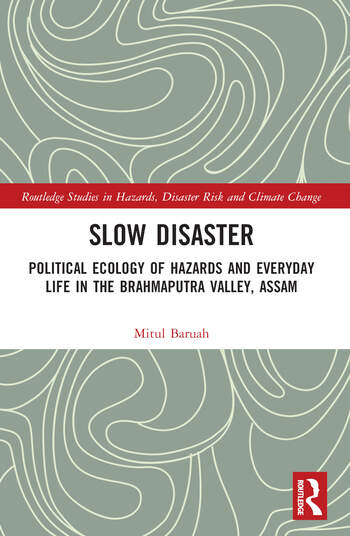
Baruah, M. (2023). Slow disaster: Political ecology of hazards and everyday life in the Brahmaputra Valley, Assam. London: Routledge. ISBN 9780367509781 (paperback; 49USD)/ ISBN 9781003051565 (ebook; 49 USD)/ISBN 9780367509774 (hardback; 150 USD).
(URL: www.penguin.co.uk/books/455147/is-a-river-alive-by-macfarlane-robert/9780241998212)
Anup Kumar Saha
South Asian University, New Delhi
To cite this review: Saha, A, K. (2026). Review of of “Slow Disaster: Political Ecology of Hazards and Everyday Life in the Brahmaputra Valley, Assam", Routledge, by M. Baruah, Water Alternatives, https://www.water-alternatives.org/index.php/bor/776-slow
The Chaura/Chapori, a community living on the sandbars of northeastern Assam, India, receive limited scholarly attention and are consequently erased from discursive constructions of the local. Baruah studies Chapori, living on the sandbar called Majuli, an island in the Brahmaputra valley. He provides a lucid and fine-grained text on how the twin processes of flooding and riverbank erosion that shape a shifting existence are centred on the sinews of culture. Mitual Baruah has intuited how resilience and coexistence within and beyond the community shape the particularity of the local. Drawing from political ecology, posthumanism, and postcolonial stances, Baruah lays the epistemological foundation for studying the lives of riverine communities on Majuli. He demonstrates how the struggles of riverine communities, through floods and erosion that shape their lived realities, inform the everyday politics of Majuli. Offering an ethnographic study, Barua’s founding argument is that floods and erosion are ‘intertwined phenomena and causally linked’ (p. 6). He traced the island’s shifting relationships between land and water, nature and culture over time, leading him to proposing the concept of ‘slow disaster.’ This framework offers a theoretical and methodological lens to study the island’s gradual transformation and how ‘low-intensity’ floods transmit the community’s shared sufferings. Baruah documents popular resistance and activism grounded in the everyday, showing how non-violence becomes a site of resistance for the Chapori.
In the first chapter, Baruah dwells on living memories of floods, devastation, loss, and recovery to offer a history of the island’s formation. In the second chapter, he explores how natural and anthropogenic processes shape the geography of the Island, providing an extensive account of Majuli’s unique wetland ecology. He then shows how outmigration (people leaving) and rehabilitation (a word used to talk of people being resettled) have continually reshaped the island and transformed its demographic and cultural landscape. In the third chapter, Baruah reconstructs the history of floods and riverbank erosion. He argues that colonial modes of development, such as embankments, the most common flood-control infrastructure, function as a form of state-led systemic dominance. The fourth Chapter outlines the political ecology of livelihoods, focusing on their crisis, decline, and diversification. Baruah moves beyond the traditional notion of “landholdings”, noting that land in Majuli “erodes, disappears, and relocates” (p. 90), and shows how agrarian livelihoods are entangled in caste and social relations. The fifth and final chapter discusses the roles of non-state actors, civil society organizations, and elite members in shaping anti-erosion activities and social mobilizations, particularly through popular activism epitomized by petitions as a form of protest.
The book navigates cases, events, and incidents that have contributed to shaping the discourse on riverine politics in South Asia. It explores the political economy of the colonial state, the processes of building hydraulic infrastructures, and their long-term impact on the floodplains of the Brahmaputra Valley. Despite its many strengths and attention to issues of everyday resistance, the most notable limitation of this book is the lack of explicit reference to the issue of justice, hence raising the question of what motivates Baruah’s commitment to shed light on how Majuli’s environment shape local existence.
Overall, the book makes an important contribution to understanding how communities are transforming through ecology and cultural integration into national networks and power relations in the context of a changing climate. Kuntala Lahiri-Dutt (Lahiri-Dutt & Samanta, 2013) and Naveeda Khan (Khan, 2023) studied the epistemology and ontology of the Chapori, respectively. Mitul Baruah extends this scholarship through a newer form of postcolonial ethnographic writing that foregrounds local narratives, vernacular expressions, and situated experiences of floods, erosion, and protection.
References:
Khan, N. (2023). River Life and the Upspring of Nature. Duke University Press: Durham and London.
Lahiri-Dutt, K. & Samanta, G. (2013). Dancing with the River: People and Life on the Chars of South Asia. Yale University Press: New Haven.