
The Water Dissensus – A Water Alternatives Forum
Newcomers who seek to redefine the multilateral global water agenda: what is their legitimacy?

By Farhad Mukhtarov and Des Gasper
Since the end of WWII, the global freshwater governance regime has focused on institution-building through multilateral organisations within the United Nations and Bretton-Woods systems (see e.g., Conca, 2006). It produced a patchy and fragmented governance landscape with imperfect international law, misaligned national-level regulation practices, and a broad range of initiatives that contributed only modestly to resolving water justice challenges (Molle and Blanchard, 2022; Varady et al., 2022). Nevertheless, this patchy governance ecosystem has been accepted as legitimate within the multilateral world order. This world order is now challenged by powerful newcomers, who have entered the global stage and claim legitimacy by high-volume knowledge production and networking. Below, we identify three such newcomers, the Organisation for Economic Cooperation and Development (OECD), Global Water Intelligence (GWI) and the Government of the Netherlands and suggest that more research and policy attention is needed to examine their work and claims to legitimacy.
In our recent Water Alternatives article, we looked at the OECD, which has positioned itself since 2009 as a central node and authority in water governance (Mukhtarov et al., 2026). Based on computer-assisted quantitative and qualitative analysis of 55 large OECD reports (2009-2022) amounting to more than 8,000 pages, we identified major topics, actors and their relationships. In this Dissensus piece, we present unpublished data from network analysis to support our arguments; for more details we direct readers to our published paper and the project dataset (Mukhtarov, 2022).
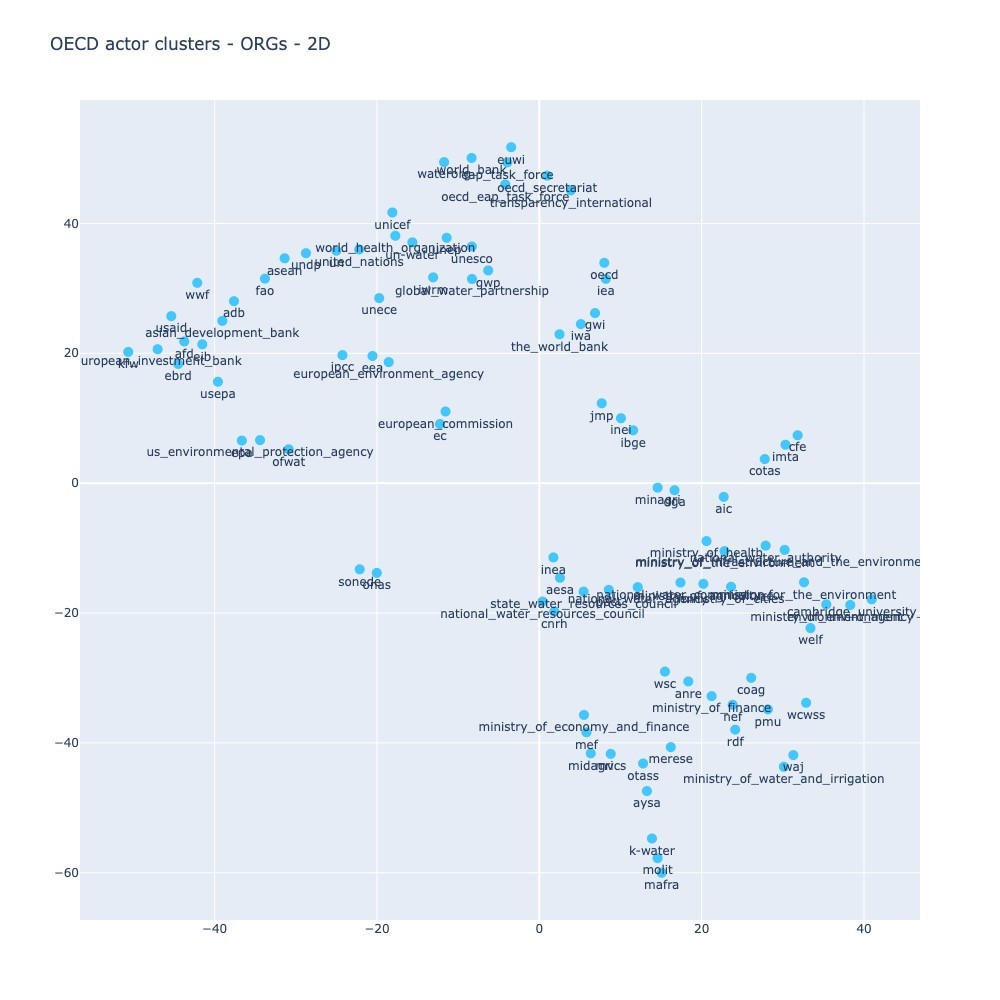
First, a simple count of named organisations in the whole corpus showed that the mainstream actors still dominate in the texts. The OECD is the most prominent one, followed by the World Bank (WB), the European Commission (EC), the Food and Agriculture Organisation (FAO), and the World Health Organisation (WHO). Secondly, we clustered the 100 most frequently named organisations in the corpus based on their embeddedness in the text (Figure 1). In a nutshell, the computer model keeps track of hundreds of collocates of particular terms (i.e., habitually juxtaposed words, in our case, key organisations), and when those collocates are similar, the organisations are placed close to each other in a 2-dimensional graph. Axes X and Y do not have a meaning; it is the distance between the nodes that matters.
A clear divide emerges between International Organisations (IOs) and regional players (e.g., the European Commission, Intergovernmental Panel on Climate Change, United Nations, The Association of Southeast Asian Nations) in the top-left corner and national level players (e.g., Korean, Japanese) in the bottom-right corner. It means that these actors are embedded in texts with different vocabulary (i.e., topics, word choices, locations). As an illustration, IOs are likely to appear in the vicinity of words such as "finance", "governance", and "efficiency", whereas national level water utilities may be associated with words such as "leakage" and "non-revenue water". Such findings do not make conclusive claims but point to interesting associations to investigate further.
Thirdly, and most revealingly, we investigated who are the top-5 organisations mentioned for each of the eight topic clusters that we identified in our published article (these are in sequence of importance: good water governance; financing water; water supply and sanitation; agriculture; water quality; disaster risk management; climate change; and The Netherlands). We found that the OECD and Global Water Intellingence (GWI) appear in 6 out of 8 major topics. This suggests the broad roles of the OECD and GWI in the subject matters of the documents. In addition, The Netherlands is the only country that formed a topic of its own, one of eight, in our topic modelling exercise (see Mukhtarov et al., 2026), which suggests its importance in the corpus.
To validate these findings, we further looked at the sub-corpuses of, respectively, 19 and 14 OECD reports that are representative of the two most prominent topics in the corpus ("good water governance" and "financing"). The results corroborate the importance of Global Water Intelligence and The Netherlands as actors that are both frequently mentioned and with the mentions spread across various documents. GWI surveys, reports and newsletters are regularly referred to in the graphs and calculations of the OECD. In one instance, the OECD acknowledges that its survey was designed to be compatable with the GWI data (OECD, 2009: 94). GWI has been carrying surveys on water utilities' performance since 2003; it is not surprising that the OECD relies heavily on their databases. Nine of GWI reports are cited in the OECD (2010) flagship report on innovative financing models for water, an organisation that is second only to the World Bank as a source of evidence (Mukhtarov et al., 2026).
Our network analysis of organisations in the OECD corpus thus points to three organisations that are important in the corpus: the Government of The Netherlands, GWI and, more expectedly, the OECD itself. We have discussed the OECD (Mukhtarov et al., 2026) and The Netherlands (e.g., Mukhtarov et al., 2021) as aspiring global forces in earlier papers. We would like now to focus on the other organisation, Global Water Intelligence, an Oxford-based consulting and research firm that has escaped any attention in research on water governance. Such lack of attention is true for the private sector consultancy world as a whole; we know too little about how they work and the source of their legitimacy, despite the sizeable role they play in both policy implementation and policy knowledge production (e.g., Burchard-Levine et al., 2024). This is a serious gap.
On its website, GWI introduces itself as "the leading publisher and events organiser serving the international water industry. Over the last 20 years we have built our business around being a trusted interface between our clients and their markets, providing our customers with high-level intelligence that enables them to make the most informed strategic decisions for their business" (GWI, 2026). Its owner and publisher is active in global water networks, but the organisation has escaped any scrutiny or analysis despite its influence on how public and private funding flow in the water world.
A trend is clear and raises concerns: actors such as the OECD, the GWI and The Netherlands Government are not mandated to set the global water agenda. The OECD's legitimacy is based on its hugely prolific knowledge production practices; we found those practices to be self-referential and flawed (Mukhtarov et al., 2026). GWI provides business analytics for private investors and bankers, as well as to international organisations, but their reports are hidden behind the paywalls and no single academic study sheds light on how they operate. And The Netherlands Government is preoccupied with promoting its own interests and those of Dutch private sector companies, in the first place, before solving global water challenges.
To make their self-assigned leadership even more notable, The Netherlands Government and the OECD teamed-up in 2022 to convene what is now an increasingly an influential elitist actor -- the Global Commission on the Economics of Water (GCEW) that, in its own words, aspires to create "a sea change in how we value, manage and use water" (GCEW, 2023: 4). The messages it spreads and its legitimacy have been questioned by many commentators (Heller et al., 2023; Puy and Lankford, 2024; Linton and Saade, 2024).
How has the growing influence of these elite actors in global water agenda setting been formed? What are their legitimising strategies? What are the safeguards that global public interests won't be downplayed in pursuit of specific vested interests? How do we ensure accountability in the complex but essential processes of knoweldge production? These questions remain without answers, but are rather urgent, for example in the context of the upcoming 2026 UN Conference on Water in the United Arab Emirates.
References
Burchard-Levine, A., Huitema, D., Jager, N. W., & Bijlsma, I. (2024). Consultancy firms' roles in policy diffusion: a systematic review from the environmental governance field. Policy Sciences, 57(3), 691-718.
Conca, K. (2006). Governing water: Contentious transnational politics and global institution building. Cambridge, MA: MIT Press.
Global Commission on the Economics of Water (GCEW). (2023). The what, why and how of the world water crisis:Global Commission on the Economics of Water Phase 1 Review and findings. Paris: Global Commission on theEconomics of Water.
Global Water Intelligence (GWI). (2026). About GWI. Online: About GWI | GWI (accessed on 6 March, 2026).
Heller, L., Karunananthan, M., Zwarteveen, M., Hall, D., Manahan, M. A., & Diouf, F. (2023). What water will the UN Conference carry forward: a fundamental human right or a commodity? The Lancet, 402(10404), 757-759.
Linton, J. and Saadé, M. (2024). Global water and its (anti)political consequences. Water Alternatives 17(2): 491-509
Molle, F. and Blanchard, M. (2022). World Water Forums, knowledge production and the imagined "Global Water Community". G-EAU Working Paper/Rapport de Recherche No.14. Montpellier, France.
Mukhtarov, F. (2022). Main Corpus on OECD reports on water between 2009 and 2021. Erasmus University Rotterdam (EUR). Dataset. https://doi.org/10.25397/eur.21687632
Mukhtarov, F., Gasper, D., Alta, A., Gautam, N., Duhita, M. S., & Hernández Morales, D. (2022). From 'merchants and ministers' to 'neutral brokers'? Water diplomacy aspirations by the Netherlands–a discourse analysis of the 2011 commissioned advisory report. International Journal of Water Resources Development, 38(6), 1009-1031.
Mukhtarov, F., Gasper, D., Farrelly, M., Lüken, M., & Moodley, K. (2026). OECD's Methods of Legitimation and Self-Authorisation in Water Governance. Water Alternatives, 19(1), 1-30.
Organisation for Economic Cooperation and Development (OECD). (2009). Managing Water for All: An OECD perspective on pricing and financing. Paris: OECD.
Organisation for Economic Cooperation and Development (OECD). (2010). Innovative financing mechanisms for the water sector. Paris: OECD.
Puy, A., & Lankford, B. (2024). The Water Crisis by the Global Commission on the Economics of Water: A Totalising Narrative Built on Shaky Numbers. Water Alternatives, 17(2).
Varady, R. G., Albrecht, T. R., Gerlak, A. K., & Haverland, A. C. (2022). Global water initiatives redux: A fresh look at the world of water. Water, 14(19), 3093.
Comments 5
In the realm of studies and research, it seems to me that scholars as well as institutions acquire "legitimacy" by producing work whose quality is confirmed by peer reviewers. Where there is disagreement, additional research and debate normally leads to improved insights, though not necessarily "agreement". OECD and The Netherlands produce work that is well-recognized though of course their results can be disputed. Generally, they go through fairly open processes of peer-review and discussion before publication. I agree with you on GWI: since its finds are not public but behind a paywall, their findings may well be self-seeking.
GCEW is a different case. Its origin is described in your blog, though you do not mention the reputation of its leadership; and I believe its work was done transparently with a lot of peer review. What you did not mention is that it has now been incorporated into IWMI as a way of continuing its work. IWMI's work is all in the public domain (as is the case for all CGIAR centers) and subject to peer review. Its influence is based on the quality of its work and its reputation.
So, while this blog is thought-provoking, I wonder if it really raises a critically important issue. I look forward to others' comments. [To be transparent, I am the editor of the Forum.]
Thanks, Doug, for these critical remarks. Legitimacy is a complicated business -- there are many types of it. A classical typology is input (what type of knowledge, whose voices, what process) and output (effectiveness in solving problems or achieving goals of actors) legitimacy. There is also a political element of course -- whose interests and purposes are being served matters -- they will usually find and advocate for legitimacy of an instititution (there are always relative winners and losers, as any course on political science 101 would teach). Throughput legitimacy is what you referred to (openness, transparency, accountability mechanisms, procedure to contest/debate).
We have not looked at all of these, but only at discursive legitimation -- how an organisation uses language to create/maintain its legitimacy (by the way, there is nothing wrong here, we all constantly legitimise ourselves daily in our language). The OECD, being a knowledge institution, bases its legitimacy on the quality of its knowledge claims. So we looked at what authorities they draw on in their work. That's separate from "acceptance" by the peers because, as we write in the paper, the audience is policy-makers who typically don't have time to execute analysis of how reports were produced (based on what types of knowledge).
Our analysis points to a gap in knowledge bases. This can be solved by a) being open to more critical scholarship on the topics the OECD works on (e.g. water governance, but also blue economy, circularity, urban planning), stepping away from the imperative to produce simple but not so useful perscriptive models of how governance should happen (e.g. 12 principles with dozens of indicators) but pay attention to how it is actually governed (power, vested interests, path-dependencies) and by being more careful with who you reference in your reports (overwhelming referencing of international organisations and consultancies and, surprisingly, OECD itself).
As for the Netherlands, it's also complicated. The tensions between own interest and global public interests have been there always and are common to all global actors. Win-wins are possible, the discourse goes, but tensions are there and examples of win-wins, to my knowledge, are limited.
The research of various scholars consistently shows that one's own interest trumps public interest when conflicst arise. Not always because of evil intentions but for all kind of reasons, including bureaucratic set-up, path-dependencies and culture. Blame is not the right strategy for improvement but a constructive dialogue, that's what I hope to achieve with my work.
On GCEW, we base our brief observations on published articles we cited. We can't say anything more than that it's remarkable for such an institution to emerge and speak on world's behalf. IWMI would give it institutional legitimacy indeed, other forms of legitimacy could then be further strengthened. And should be strengthened by gaining public trust.
Legitimacy is a flipside of accountability. How can these organisations be accountable to those who use their knowledge? That's not such a crazy question given the ambitions and policy impact (certainly media impact) those organisations have.
I find the article very thought-provoking, particularly its focus on the legitimacy of actors shaping the global water agenda. I agree that knowledge production has become a central source of influence, but not necessarily a sufficient basis for legitimacy.
From my experience in the Colorado River basin in Argentina, these issues are not merely theoretical. The legitimacy of decisions does not rely only on the technical quality of studies or reports, but also on the ability to build agreements among jurisdictions with often conflicting interests. In such contexts, conflict does not disappear; rather, it is channeled through institutions that, over time, can generate a certain degree of stability.
In this sense, I find particularly valuable the idea raised in the forum about disagreement as a learning process. In practice, water governance involves continuous negotiation, where technical knowledge is necessary but not sufficient to sustain decisions that are broadly accepted.
This is why the growing influence of organizations such as the OECD or global consultancies raises an important tension: to what extent does this knowledge reflect the diversity of local contexts and realities? And, at the same time, how is legitimacy constructed when those producing knowledge are not directly involved in the territorial processes where their recommendations are implemented?
I believe these questions become even more relevant in contexts of increasing water scarcity, where decisions must not only be efficient, but also perceived as fair by those who depend on the resource.
Dear Javier,
Thank you for your careful and important contribution. I cannot agree more -- global actors often lack contextual knowledge of the issues in a particular place and lack relationships with end-users and other important actors.
Water management is relational (much work on this by Margreet Zwarteveen, Rutger Boelens, Raul Lejano, Lyla Mehta) and knowledge is always situated (e.g. Haraway 1988). So claims of universal principles are useful as general heuristics to start a conversation, but not sufficient to create connections, generate deeper understanding and move things forward (not without conflicts but with a process that allows its diffusion).
In our research we did look a bit on differences in claims the OECD makes in its global reports (general issue focus) and reports that focus on case studies. We found important differences (e.g. that financing is generally discussed in global reports and governance more often in case study reports). We still need to digest and interpret the findings.
The gist of what you say remains true nonetheless -- actors without local grounding in knowledge and relationships won't gain trust of a broad range of actors needed for collaborative water governance. With top-down models of governance, it's another story.
SSO ID - SSOID Rajasthan Login & Registration sso.rajasthan.gov.in
With a Rajasthan Single Sign-On ID (Single SSO ID), users can access more than 100 online services. Through this page, we will provide all information related to SSO ID Login, the SSOID registration process, its uses, and more in both English and Hindi languages.
SSO ID Rajasthan Portal Login, Registration, Forgot Password, eMitra, Jan Aadhaar, Recruitment Services and complete guide for sso.rajasthan.gov.in.